Repair works when the damage is still localized, a tear, a burn, a small crack. Reupholster when the wear has spread across multiple panels or you want a different look entirely. Replace when the actual structure underneath, the foam or the frame, has failed and no amount of surface work will fix it. Here's how to tell which one your seats actually need.
The Three Options at a Glance
| Damage or Situation | Likely Option |
|---|---|
| Small tear or puncture | Repair |
| Cigarette burn | Repair |
| Small crack, still surface-level | Repair |
| Faded dye or minor discoloration | Repair |
| Widespread cracking across the seat | Reupholster |
| Multiple torn or worn panels | Reupholster |
| Sagging or collapsed foam, frame still sound | Reupholster (with foam replacement) |
| Damaged or bent seat frame | Replace |
| Airbag or seat-sensor involvement | Professional assessment first |
| Seat beyond structural repair | Replace |
These are starting points, not guarantees. The real answer depends on what's actually going on underneath the surface, which is exactly why we look at the vehicle before recommending anything.
When to Repair
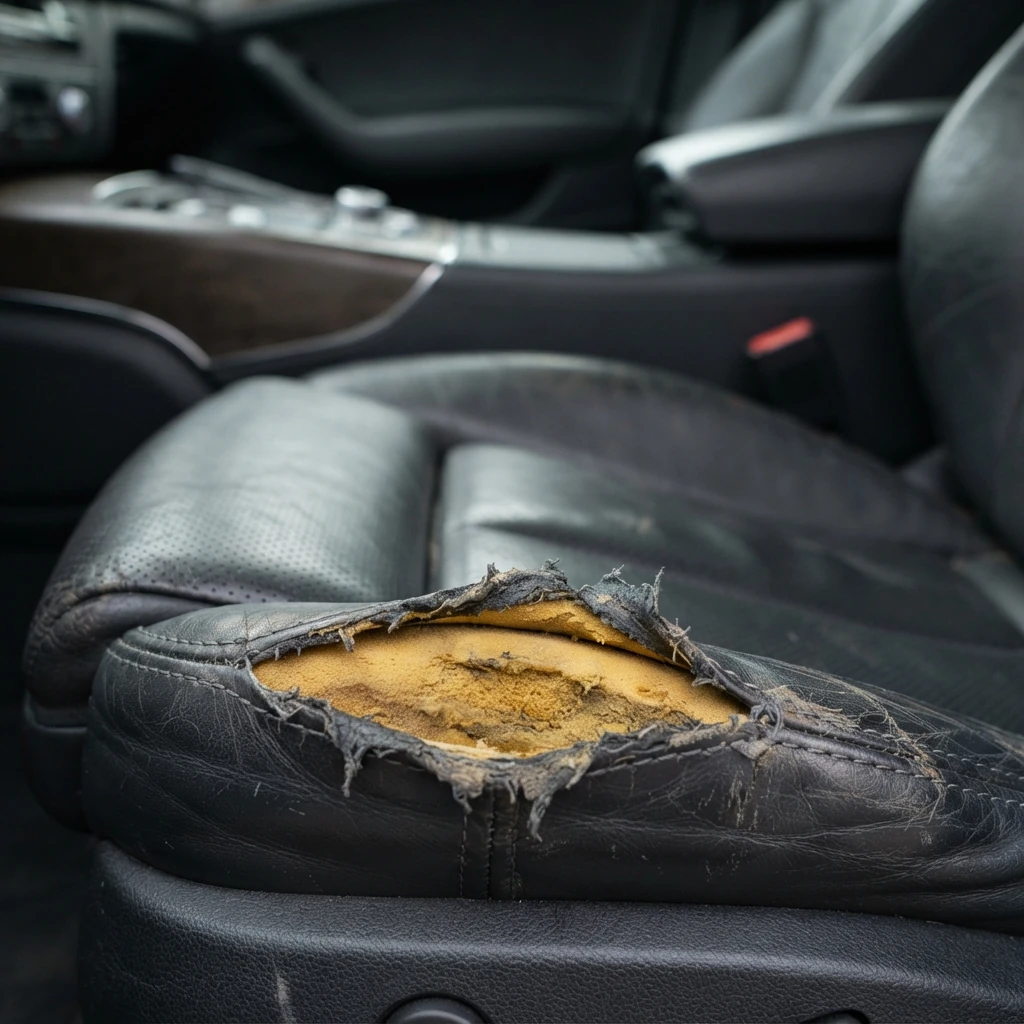
A small tear or puncture from a key, a zipper, or a pet claw can usually be filled and blended without touching the rest of the seat.
A minor crack that's still surface-level, meaning it hasn't spread or deepened, responds well to filler and color-matching.
Scuffs and abrasions, especially on high-contact spots like bolsters and seat edges, clean up with targeted work rather than a full recover.
Isolated seam damage on one section can be restitched without opening up the whole seat.
Surface staining or discoloration that hasn't deeply penetrated the material can often be cleaned and redyed to match.
When to Reupholster
Cracking or wear spread across multiple panels is the clearest signal. Once damage isn't contained to one spot, patching each area individually stops making sense, and a full recover gives a more consistent result.
Foam that's started sagging while the frame is still sound is a common reason to reupholster, since new foam underneath new material resets both comfort and appearance at once.
Wanting a different material, color, or stitching pattern is its own reason to reupholster, separate from any actual damage. If that's your main goal rather than fixing wear, that's really a customization decision more than a repair decision, and it's worth thinking about separately from what condition your current seats are in.
When to Replace
"Replace" gets used loosely, and it actually covers four different things: replacing just the upholstery cover (which is really reupholstery), replacing the foam underneath, replacing the seat frame, or replacing the entire seat assembly. Each is a different job at a different price point, so it's worth being specific about which one you actually need before assuming the most expensive option is the only path.
A damaged or bent frame is the clearest real signal for frame or full-seat replacement, since no amount of surface work fixes a structural problem underneath.
A seat that's already been through a failed repair or DIY attempt, where the patch has cracked, peeled, or mismatched badly, is often better served by starting over than layering another fix on top.
Damage severe enough that patching would only be a short-term fix points toward replacement rather than spending money on repair work that won't hold up.
A Real Word of Caution: Seat Airbags & Safety Systems
Modern seats often have more built into them than most people realize: side airbags, occupant sensors, seat heaters, and the wiring that runs all of it. That means a seat's condition isn't just a question of how the upholstery looks. If your seat has any of these systems, it genuinely needs an in-person, qualified assessment before any repair, reupholstery, or replacement work starts, rather than a judgment call based on the surface alone. This isn't about talking you into a bigger job than you need. It's about making sure the actual safety-relevant components get handled correctly, whatever the final scope of work turns out to be.
Is It Cheaper to Reupholster or Replace?
Generally, yes, reupholstering a seat with a sound frame costs less than sourcing a full replacement seat, especially on older vehicles where original replacement seats can be expensive or simply no longer available. Based on typical market pricing, a straightforward repair often starts somewhere around $80 to $125, with a fuller repair job closer to $250. Reupholstery tends to run higher, often starting around $160 and climbing toward $400 or more per seat depending on material, with leather generally costing more than vinyl or cloth. These are market ranges, not a Lusso quote, and most shops honestly can't give you an exact number until the seat is actually opened up and the real scope of work is visible. For a full breakdown of what Lusso itself charges, see our complete cost breakdown.
The "why not just buy new seats entirely" question comes up a lot, and the honest answer is that full OEM replacement seats are usually the most expensive path, and they can be genuinely hard to source on an older vehicle. If your frame is sound, reupholstering it typically costs less and lets you choose your own material and color instead of settling for whatever replacement is available.
Does Reupholstering Affect Your Car's Value?
It depends heavily on what kind of vehicle you're actually talking about. For a rare or highly collectible classic, keeping the original material intact usually matters more to value than a fresh reupholstery job, even if that original material looks tired. For a daily driver, or a car you're not planning to sell as a collector piece, reupholstering to a good standard is a reasonable improvement rather than something that risks the car's value. We won't promise a specific increase in what your car is worth, since that depends on too many factors outside the seats themselves, but a clean, well-done interior generally reads better to a buyer than a worn one.
Getting an Honest Assessment for Your Seats
The right call for your specific seats depends on things a general guide can't see from here. We have a form where you can tell us what's actually going on with your seats, the damage, the material, how it happened, and we'll go from there. Take a look at our auto upholstery services, or book an assessment and we'll tell you plainly whether you're looking at a repair, a reupholstery job, or a replacement.
Frequently Asked Questions
Is it cheaper to reupholster a seat or buy an entirely new one?
Reupholstering a seat with a sound frame is typically less expensive than sourcing a full replacement seat, especially on older vehicles where original replacement seats can be pricey or hard to find at all.
Can I repair just one damaged panel instead of reupholstering the whole seat?
Yes, if the rest of the seat is in solid shape, a single-panel repair is usually the better value. Reupholstering the whole seat makes more sense once multiple sections are cracked or worn.
Does torn or cracked upholstery mean something is wrong underneath?
Sometimes. Torn material can be hiding collapsed foam or a damaged frame underneath, which is exactly why an in-person look matters more than judging by the surface alone.
Will a repaired or reupholstered section match the rest of my interior exactly?
A skilled repair or reupholstery job can get very close, but an exact match isn't always possible on older, sun-faded, or heavily worn interiors, and we'd rather tell you that upfront than oversell what's realistic.
What is the "$3,000 rule" people mention alongside car repairs?
It's unrelated to upholstery. The $3,000 rule is a rule of thumb about whether a repair bill is large enough that replacing the vehicle makes more financial sense than fixing it, a car-ownership concept that has nothing to do with your seats specifically.